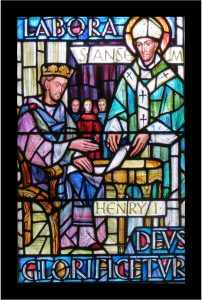
Part of a window in Norwich Cathedral, showing St Anselm in conversation with King Henry I.
Anselm of Canterbury was a monk, an abbot, a philosopher, a theologian and an archbishop.
He was born in around 1033 in a town called Aosta, then a part of Upper Burgundy and now in Italy. His father was a noble and his mother was the daughter of a luminary who rejoiced in the name of Conrad the Peaceful – who was king of Upper Burgundy. Anselm’s mother it was who looked after the family estates as she was good with money – which Anselm’s father wasn’t!
Anselm was devout and at fifteen wanted to enter the religious life – but his father wouldn’t give consent so he was refused entry by the abbot.
After the death of his mother, his father repented of his somewhat dissolute lifestyle and became rather draconian and Anselm, at 23, left home and, having crossed the Alps moved around France for a time. Pursuing his dream of a monastic life he met Lanfranc (then Prior of Bec) and, when Anselm’s father died, he entered the Benedictine abbey at Bec and became a novice. He was 27.
He began writing immediately – first in the field of philosophy. Over the next ten years or so, he grew in stature and holiness.
It was in 1063, when Lanfranc, the Prior, was appointed abbot of a new abbey, that Anselm was named as Lanfranc’s successor as Prior and, after some initial disagreement – mainly because of his young age – was elected by the monks of Bec. In 1078, when the founder of the abbey of Bec – a man called Herluin (who had been a warrior-monk) – died Anselm was unanimously elected as the new abbot of the important monastery of Bec. A year later he was consecrated bishop of Evreux. With Anselm as abbot, Bec became one of the foremost places of learning in Europe – attracting students from all over the place. Anselm wrote his Proslogion and Monologion during this time, his most important works.
The monastery was famous, not just for learning, but also for spiritual discipline, and the good, kindly and loving example of its abbot, Anselm. It also became even more well-known, when Anselm defended the monastery from both control by the archbishops and by the nobility, in the forms of the Archbishop of Rouens and the Earl of Leicester!
As a bit of an aside – the monastery had been given big property interests following the Norman conquest – in particular the land around a tiny village known as Ruislip in fact, where a priory was founded, just down the road from Hatch End.
Anselm visited Lanfranc – his old prior – who was by now Archbishop of Canterbury and became well respected at Court.
He was named successor to Lanfranc, but when Lanfranc died King William II (William Rufus) refused to allow anyone to sit in the See of Canterbury and grabbed all the land for the Crown, vowing there would be no Archbishop while he lived. William Rufus then promptly became seriously ill and, somewhat in fear of his life, he asked Anselm to hear his confession and give him the last rites. The King then released all those he had imprisoned, paying all his debts along the way.
In 1093, the King himself nominated Anselm as Archbishop of Canterbury. The clergy, bless them, carted Anselm off and forced the crozier into his hands. But initially the monks at Bec would not consent to him being archbishop and Anselm himself refused to start with.
In the end, after much negotiation – during which the king agreed to return the lands and wealth he had stolen from the church – Anselm did indeed become Archbishop of Canterbury.
Archbishops of the time were granted a pallium – a woollen vestment given by the Pope – and they were expected to travel to Rome to receive it. Anselm insisted he be allowed to do this but the king refused him permission. This was because at the time there were two Popes (we won’t go into that) and the king would not allow Anselm to travel to see either of them until he, William, had made up his mind which was the proper one!
In the end, he was enthroned at Canterbury without a pallium on 4th December. The king wanted Anselm to be removed from office and he sent emissaries to Rome to ask for another to be awarded the pallium and to receive the Pope’s blessing as Archbishop of Canterbury but the moment the king acknowledged Urban as Pope the fellows he had sent refused to do anything other than recommend it be passed to Anselm. The king wanted Anselm to receive it from him – which would have shown the church as subservient to the throne but Anselm refused. In the end, the pallium was placed on the altar at Canterbury, from where Anselm took it.
About four years later the king quarrelled again with Anselm and, in the end, gave him a stark choice, to be exiled or to surrender completeky to the Crown. Anselm left for the continent and William promptly took back all the church lands again, as he had before. Anselm, now in the company of the Pope worked on more theological works and was a powerful speaker and advocate in the great theological debates of the time in the councils of the church.
After William’s death, there was more intrigue when the new king, Henry I, wooed Anselm back with promises to take his counsel and work with him, but behind the scenes demanded Anselm submit to him. Again Anselm refused and travelled back to Rome – the result of which was a threat by the Pope to excommunicate the new king. So Anselm went into exile a second time.
Anselm would not return to Canterbury but stayed at the monastery in Bec until Henry came to negotiate with him. The king restored the lands and churches stolen by him to the church and the rights of the church against the monarch were strengthened greatly – with the king formally renouncing the right of English kings to create and control bishops.
Anselms last years were spent in the duties of the Archbishopric leaving the English church a vastly stronger and more spiritually independent place than it had been.
Anselm died on 21st April 1109 and was made a saint in 1163.
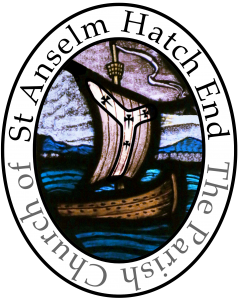
The new parish logo – updated in 2018.
Our patron lived a holy and devout life. His wisdom and strength were recognised across Europe and his theological works are counted amongst the greatest in the church along with those of St Augustine and St Thomas Aquinas.
Saints have what are called attributes – and those for Anselm are the mitre and crozier of a bishop but, in particular, the pallium and a ship – representing the spiritual independence of the church. We see these both in the old ‘logo’ of the parish and we use them in our new updated logo also.
The parish banner shows the pallium being worn by our patron too.
St Anselm exemplified one who worked tirelessly for the gospel, as a novice, as a monk, a prior, an abbot, a bishop and as an archbishop.
Despite many trials and challenges – not least from two kings sitting on the English throne – Anselm continued in his servanthood of God and of God’s church. His writings have been foundational work for many later theologians and scholars.
This, then, is the man after whom this church is dedicated. One who lived for the Lord and for the church, known as a holy and kindly man – a great example to all of Christian life and servanthood.
Indeed, his example shows us that servanthood, holiness and kindliness do not mean we have to become doormats. On the contrary, Anselm, like the Lord he served, was strong and resolute in his faith and in his dealings – truthful and constant. He never forgot those in his charge either; those he was responsible for, initially the monks at Bec and later the church he served.
In our faith, too, we are called to be constant and true to our Lord’s call – following him as the centre of our lives but always remembering and caring for those for whom we are responsible.
If we can do that – then, like Anselm, we will increasingly be living a Christian life.